

 LGBTQ Friendly!
Dental Bridges Washington DC
Losing a tooth can affect your smile, your ability to chew, and even the alignment of your remaining teeth. At Markowitz Dental of Washington DC, we offer high-quality dental bridges to restore your smile, improve oral function, and maintain your oral health. Dr. Markowitz, Dr. McGorry, Dr. Roen, and Dr. Benson provide comfortable, personalized care for patients in Washington, D.C. and nearby neighborhoods.
What is a Dental Bridge?
A dental bridge is a fixed dental restoration that replaces one or more missing teeth by “bridging” the gap. It typically consists of two crowns on either side of the gap (called abutment teeth) and a false tooth or teeth (pontic) in between. Bridges are custom-made to match your natural teeth in color, shape, and size, creating a seamless and natural-looking smile.
Before and After
Please drag-and-drop the sliders to explore our before and after pictures!
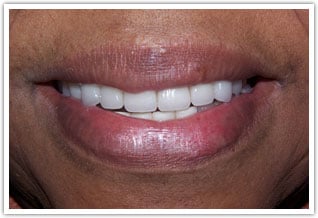
Problem: Unaesthetic smile and missing teeth. Solution: Combination of crowns, bridges, implants and a removable partial denture.
Why You Might Need a Dental Bridge
Dental bridges are recommended for patients who have:
-
One or more missing teeth in a row
-
Difficulty chewing or speaking clearly due to missing teeth
-
A desire to maintain the natural shape of their face and smile
-
The need to prevent surrounding teeth from shifting out of place
Without timely treatment, missing teeth can lead to bite problems, jaw pain, and an increased risk of gum disease. A dental bridge restores not just the appearance of your teeth, but also your oral function.
Types of Dental Bridges
At DC Smile Center, we offer several types of dental bridges depending on your needs:
-
Traditional Bridges – Uses crowns on adjacent teeth to support the bridge.
-
Cantilever Bridges – Supported by a crown on only one side; used when adjacent teeth are limited.
-
Maryland Bonded Bridges – Uses a metal or porcelain framework bonded to adjacent teeth; ideal for front teeth.
-
Implant-Supported Bridges – Anchored by dental implants for added stability; perfect for larger gaps.
Our team will recommend the best type based on your oral health, location of the missing teeth, and long-term results.
Benefits of Dental Bridges
-
Restores your smile and confidence
-
Allows you to chew and speak naturally
-
Prevents teeth from shifting
-
Maintains facial structure
-
Durable and long-lasting with proper care
What to Expect During the Procedure
Getting a dental bridge usually involves:
-
Initial Consultation – We evaluate your teeth, discuss your goals, and recommend the right type of bridge.
-
Tooth Preparation – The teeth on either side of the gap may be shaped to support the crowns.
-
Impression and Custom Bridge – We take impressions to create a bridge that fits perfectly.
-
Placement – The permanent bridge is cemented in place, restoring your smile immediately.
-
Follow-Up – We check your bite and comfort to ensure optimal results.
Schedule a Consultation in Washington, D.C.
If you are missing teeth and want to restore your smile, contact DC Smile Center today. Dr. Markowitz, Dr. McGorry, Dr. Roen, and Dr. Benson will guide you through your options and provide the best solution for your oral health. Call us or schedule your consultation online to learn if a dental bridge is right for you.
Frequently Asked Questions about Dental Bridges
What is a dental bridge?
A dental bridge is a fixed restoration used to replace one or more missing teeth, filling the gap with artificial teeth anchored to adjacent natural teeth or implants.
How long does a dental bridge last?
With proper care, dental bridges typically last 10–15 years, and sometimes even longer.
Does getting a dental bridge hurt?
Most patients experience little discomfort. Local anesthesia is used during the procedure, and any mild soreness usually resolves quickly.
Can I eat normally with a dental bridge?
Yes, a dental bridge restores normal chewing function. It’s best to avoid very hard or sticky foods to protect the bridge.
Do I need a special cleaning routine?
You can brush and floss normally, but using a floss threader or water flosser helps clean under the pontic to prevent plaque buildup.